
The Merry Life Of A Wretched Dog: Cornelius by Marc Torices
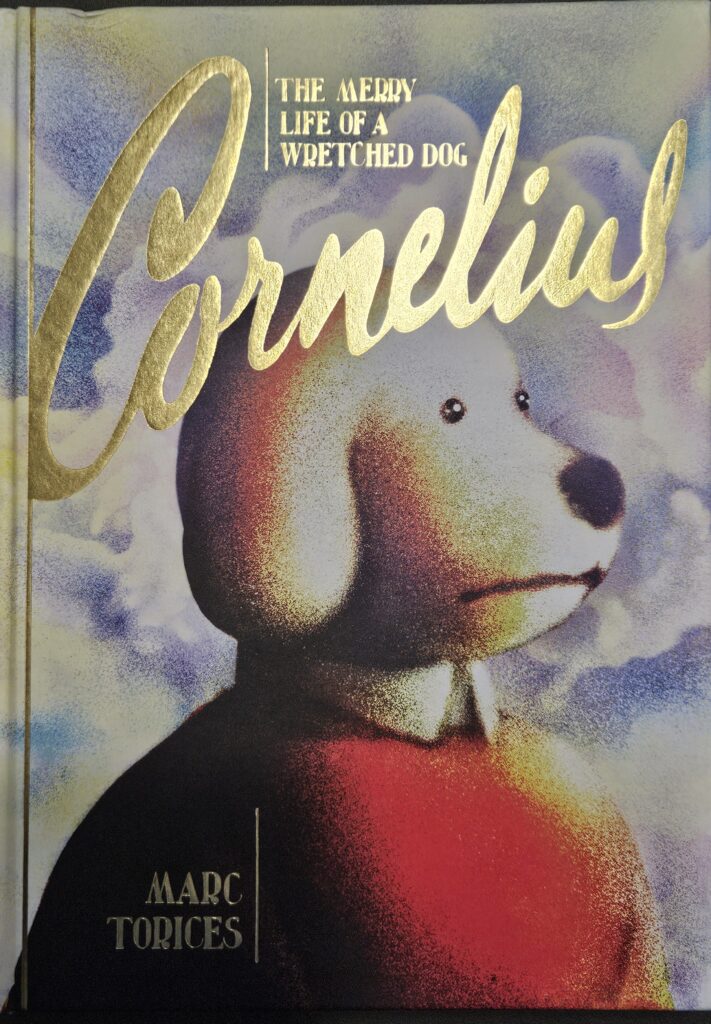
A few things you must know about this book review of Marc Torices’s, The Merry Life of a Wretched Dog: Cornelius: First, I’m brand new to the world of graphic novels. As in, this is only the third adult graphic novel I’ve ever read. Prior to that, my experience extends only as far as Calvin and Hobbes (decades ago) and sporadically reading Captain Underpants with my son. Secondly, Cornelius was NOT what I was expecting (remember Hobbes is my beginning point of reference for cartoon puppies, the other novels being memoirs); and what I think it’s about after reading it twice, somehow I feel deep inside of me, that it most definitely is not. That’s on me though. Afterall, it is in the title. Cornelius is, in fact, a wretched dog. I will say though that I absolutely adore his roommate, Avaalutsa, and the way he viciously mocks Cornelius. Sometimes it takes a cynic to love a cynic.
Before I try to tackle plot and meaning (mostly because I’m not sure there even is a plot), I think I’ll discuss what I’ve learned so far as the basics regarding the graphic novel. Afterall, this is what kept me engaged throughout the nearly 400-page labyrinth of interconnected and often contradicting events that make up Cornelius’s tale. What I know thus far is that “reading” graphic novels or comics requires you to take in both words and images together as you follow a path from the top-left eventually landing in the bottom right, though there are occasional detours (panels overlaying each other in a fight for your attention). One must “read” all the visual details given, to include the layout, alongside traditional text, though at times there are no words to lean on. You must get your paws dirty by digging deep into character expressions, body language, what clues are given in the background and foreground, color choices that fill you with emotions you’re unaware of, the space between frames (and what it does to pace when there are none), and even when there is text– the letters also contain clues based on their size, shape, and placement.
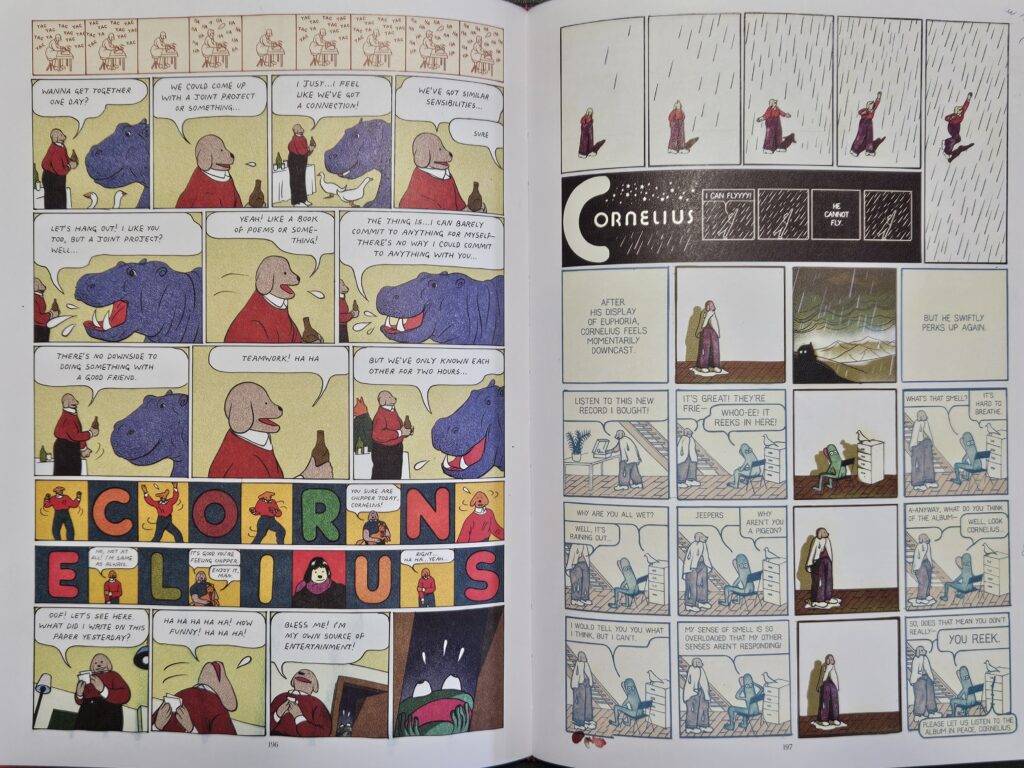
At times, it can all be overwhelming, but this is where Torices’s true talent shines most brightly, and its the reason I reread Cornelius in hopes that I could discover what message he was trying to convey. I have to admit though; at times I still feel as if Torices is simply playing games with his reader as this novel seems heavily rooted in existential dread, along with a double dose of absurdity. For me, the emotional texture was often unsettling, and I too often felt the awkward sensation of missing that top step on the stairs while people are watching you try to regain your footing. But that might just be me and my newness to graphic novels.
Here’s a big hint that I wish I had known prior to my first go-around: while studying each panel for hints about characters and plot and what the heck was going on, I took a moment to really study the artwork itself. My respect for the artistry grew, along with my acknowledgment that WOW there was so much happening within each page. And I discovered randomly placed footnote numbers! (see image)
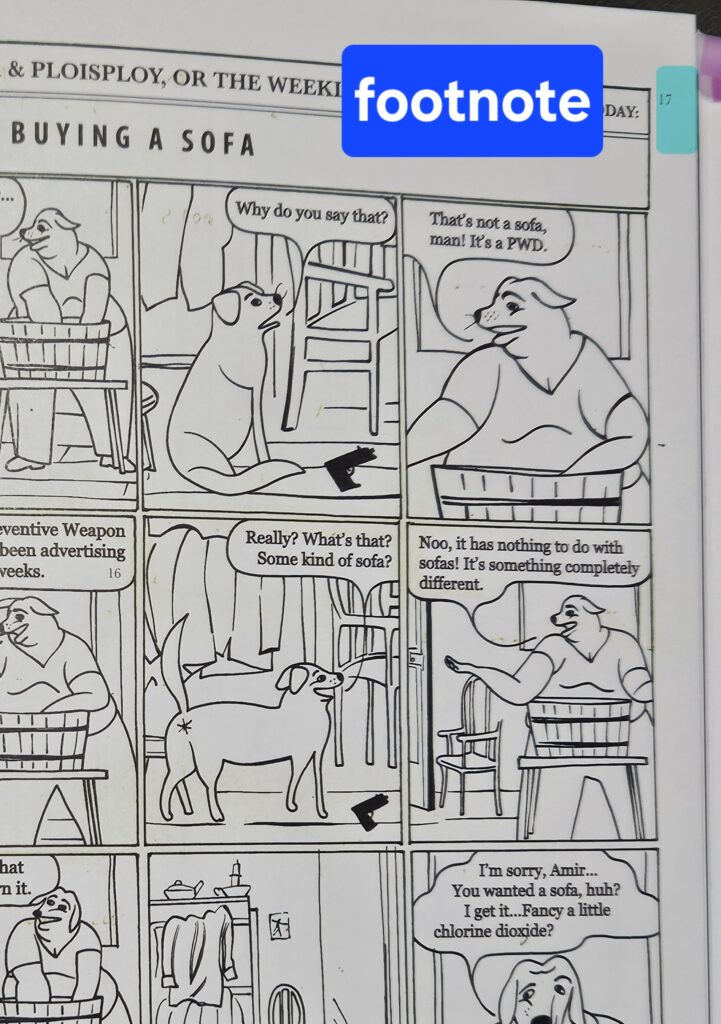
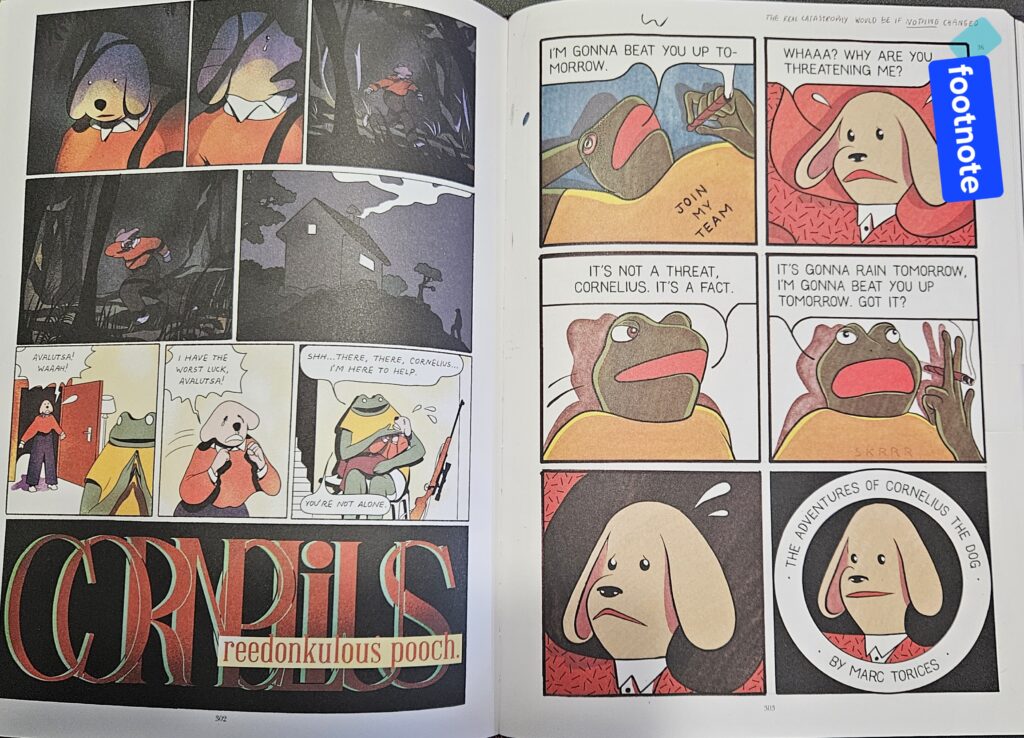
I confess, when I arrived at page 367, where it says, “THE END,” I was exhausted and slammed closed the book without bothering to see what the “Notes” section was all about. (Then I glanced around to see if anyone could see how lost and unworthy I felt.) NOTICE: This is where you need to begin your journey, not with the prologue, but at the end of the book where the Notes are hidden because it’s where Torices’s ridiculousness (I use that term affectionately) is more transparent. These notes, which must be read as you’re working your way through each segment, provide understanding (almost as their own novel) about some of the jokes or comedic relief that I’d earlier felt left out on. More importantly, they help with some of the faux history regarding the “strip” and its characters that are spawned from the world of the Republic of Maiame and are extruded from the company SLAKR. Torices’s talent as an artist shines brightly in the wide range of styles that he emulates as he forges from colorful primary shapes and lines an entire world full of its own beauty, politics, and . For the longest time, I had the impression that these strips were all carefully researched and curated for a specific narrative that I was waiting to unfold, only to discover everything was done by Torices himself. He alone was the god of this universe, and there are no doubt specific intentions behind his ink stains, pencil marks, and bits of information left here and there. I never made sense of the arrows, page numbers, notes, or what looked like blood stains. For a fleeting moment, it felt as if the structure was framed as a collection of strips with some contextual notes that would melt together as an artifact or special treat of recovered work.
I suppose this is where I should attempt to naw on the bone that is plot. The prologue gives us a lot of information regarding nothing at all, other than that this book is the first in a “series of 40-volumes that will trace the trajectory of Cornelius the Dog” (Torices 5). If you’re good at guessing, you’ll quickly figure out that Cornelius is a series of absurd but comedic strips that follow the anthropomorphous dog’s life, –while taking swings at the impermanence of the world of media advertising and its “characters” chosen to represent companies and their cultures. Apparently, this book is the celebration of Cornelius’s 300th birthday, but instead of cake and ice cream, we go on a wild ride that includes a tryst with a hippo, witness Cornelius’s first time doing cocaine with a fish and a fox, and try to analyze his relationship with his girlfriend Josefina, while also wondering how he isn’t handling the kidnapping of his friend Alspacka any better. It’s all surreal and dark, and Torices’s choice of colors and styles are competing and contradictory in a way that keeps the scenes disjointed yet purposeful. What I mean by that is Torices seems to thrive at rejecting traditional writing styles and has forged a universe where a single wretched dog fills his days with meaningless actions as he bumbles through the events that happen to him. Frankly, Cornelius is a bungling loser dealing with a touch of guilt and paranoia, is 100% a coward, but Torices keeps us engaged with this flawed character with slapstick comedy and psychological horror in a way that I just can’t understand. I kept turning pages despite feeling so uncomfortable and outwitted.
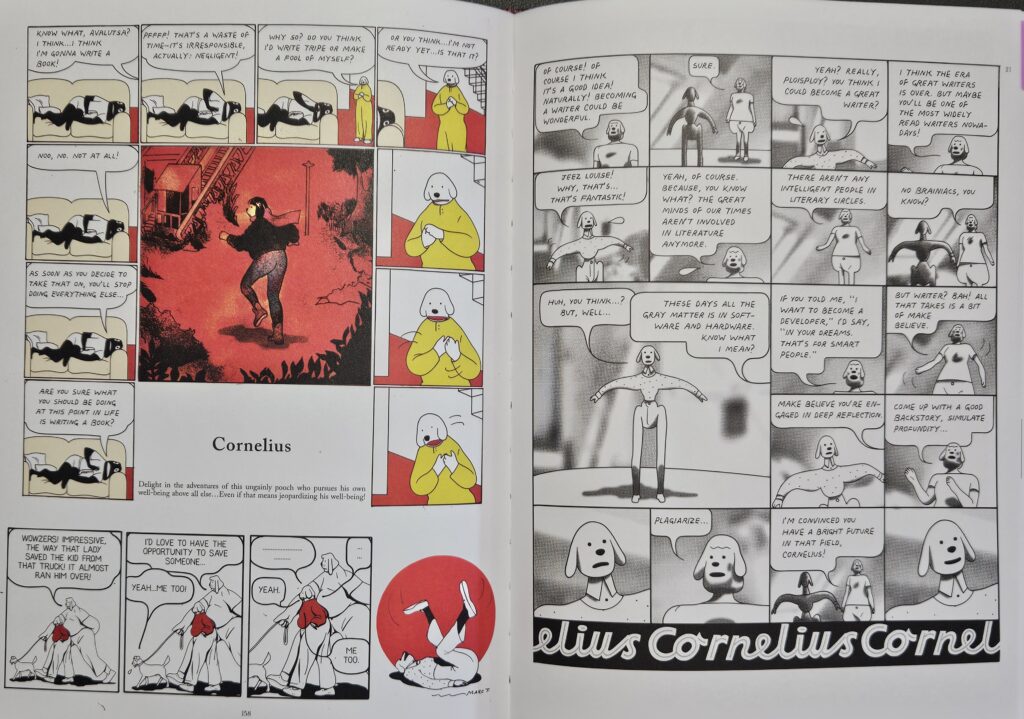
I find it impossible to categorize this novel. There is a ton of nonsense that happens between the pages and Torices masterfully weaves a fake world of events together in a nonsensical way that makes this novel very unique. The way his visual styles continue to shift and change displays the vast spectrum.
This experience was both horrifying and hilarious, and as I continue to dip my toes in the world that is adult graphic novels, I have to rate it five stars even though I felt so many contradictory emotions throughout the first and second reads. Cornelius, that wretched beast, is a spectacular train wreck, but I found that I just couldn’t stop turning the page to see what he was going to do or say next. I fully appreciate the masterful skill set that Marc Torices utilizes to convey this metatextual framework of fake publishers, along with his use of shifting artistic eras to establish how external authorship fragments a character’s identity. I think that is the point of the 400 pages, maybe. I might miss the goal, but at least I took a run at it, and I found it challenging and stimulating for an adult graphic novel. It was unlike anything I’ve ever read, and I think that was Torices’s goal. I don’t think it’s meant to give any insight into life other than at times we’re met with cruel and absurd and cowardly individuals that turn life into a very interesting moment to help us keep perspective.
Cornelius is probably not a book for everyone. It’s not a beach read or a quick plane ride escape into someone else’s life. It constantly interrupts itself and requires an intense study of the continuously adjusting styles and contorting layouts. It’s very often intentionally off-putting and may be offensive to some readers, so beware. However, the art itself is phenomenal and the massive undertaking Torices invested in the “manuscript’s” details of all the events and characters, the settings…quite frankly is just beyond words. He has my full respect and I will be picking up more of his work in the future to study, and hopefully be entertained or even challenged by.